
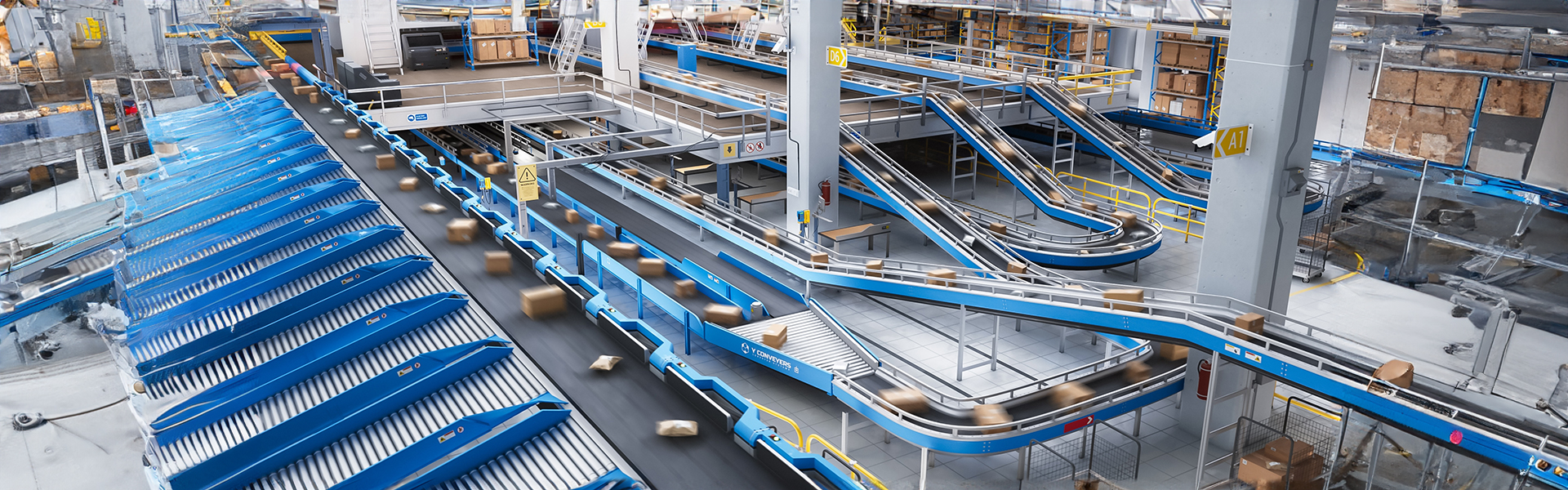
Types of Intralogistics Conveyor Systems Used in Modern Warehouses
Bottlenecks in modern warehouses limit throughput. And the myth that the problem always begins on the production floor is not entirely true.
Sometimes, the bottleneck is somewhere between machines — a pallet sitting idle because the forklift is occupied elsewhere, a case packer running at full speed. At the same time, the palletizing station downstream is backed up. The product is ready. The facility just cannot move it fast enough.
That is the problem intralogistic conveyor solutions are designed to solve. And given that the global conveyor systems are currently valued at USD 7.3 billion and are projected to reach USD 12.4 billion by 2036.
Forklifts are not the enemy. But using them as the default answer for every internal transfer creates a kind of organised chaos that compounds as volumes grow.
A well-planned conveyor network changes the logic entirely because it allows a continuous flow of products. So, let’s learn about it.
What Are Intralogistic Conveyor Solutions?
The term gets thrown around loosely, so it is worth being specific. Intralogistic conveyor solutions are conveyor systems built for movement inside a facility, not for external transport, not for large-scale sortation hubs, but for the specific task of linking operational zones within a warehouse or manufacturing plant.
In a secondary packaging context, that typically means:
- connecting case packers to palletizers,
- palletizers to stretch wrappers, and
- stretch wrappers to dispatch lanes.
The conveyor is not the star. It is the connective tissue that makes everything else work at the right speed.
Belt Conveyor Systems
Belt conveyors are the most broadly useful conveyor type in packaging environments, which is why they show up so often. A continuous belt loops over rollers and pulleys, driven by a motor, moving products along a fixed path. What makes them particularly valuable is the full-surface contact. The product rests on a moving surface rather than on a series of contact points, which matters a lot for items with uneven bases, soft packaging, or lighter weights.
Belt material gets selected based on the application:
- PVC belting covers the majority of general warehouse and packaging use cases.
- Polyurethane (PU) belting is the standard for food contact environments, where cleaning protocols and material compliance matter.
- Modular plastic belts work well where frequent washdowns or drainage are part of the routine, which is common in food processing and some chemical handling environments.
Where belt conveyors are typically specified:
- Between case packers and palletizing stations, where consistent carton support is required.
- Feeding products through check-weighers, labellers, and carton sealers without disrupting the orientation of the products being transported.
- Elevation changes, including steep inclines that gravity roller systems cannot handle.
- Accumulation sections that absorb speed mismatches between machines.
Alligator Automations builds belt conveyor systems to connect directly with their case packers and palletizers. Belt width, speed, and accumulation length are matched to the actual output rate of the line and not just pulled from a standard catalogue.
Roller Conveyor Systems
Roller conveyors take a different approach. Instead of a continuous surface, products travel across a series of rotating cylinders set in a frame. For anything with a flat, rigid base, such as cartons, crates, pallets — this works extremely well. The load spreads across several rollers at once, which means even heavy products move with relatively little motor effort.
There are two fundamentally different variants, and they suit different parts of the operation:
- Powered roller conveyors drive the rollers mechanically, allowing precise control over speed and direction. These are used where accuracy matters — automated sorting, scanning, and positioning before robotic pick operations.
- Gravity roller conveyors rely on a slight decline or a manual push to move product forward. They are simpler, cheaper, and often exactly right for accumulation areas and loading dock staging, where powered movement is unnecessary.
Roller conveyors are typically used for:
- Moving loaded pallets between palletizing stations, stretch wrappers, and dispatch lanes.
- Heavy carton and crate handling in manufacturing facilities with high throughput demands.
- Buffer and staging zones near loading bays where product queues before it goes on the truck.
Alligator Automations manufactures roller conveyor systems rated up to 2,000 kg with speeds reaching 25 metres per minute. Standard 1,200 x 1,000 mm pallet compatibility is built in, with custom sizing available. Roller diameter and pitch are specified per application.
Pallet Handling Conveyors
Pallets loaded with finished product represent the most expensive material moving through the facility at any given moment. Getting that movement wrong can result in damage from poor handling, delays from congestion, safety incidents in high-traffic zones, and is costly in every sense.
Dedicated pallet handling conveyors, whether chain-based, roller-based, or accumulating roller chain systems, are built specifically for this workload. They remove the dependency on forklifts for the short, repetitive transfers between palletizing, wrapping, and dispatch, which is also where a lot of warehouse accidents happen.
Alligator Automations designs these systems as standalone installations or as part of a fully integrated end-of-line setup, depending on the scale and complexity of the operation.
How the Full Line Fits Together
This is where the real value shows up. Individual conveyor sections are useful. A connected system that runs the entire secondary packaging and dispatch sequence is a different proposition entirely.
A typical integrated line runs in this sequence:
- Case packers prepare and seal cartons.
- Belt conveyors carry cartons to a robotic palletizer.
- Roller or chain conveyors move loaded pallets to a stretch wrapper.
- Pallet handling conveyors deliver wrapped loads to dispatch lanes.
- An automatic truck loading system closes the loop.
Alligator Automations designs and builds complete lines of this type, integrating bagging machines, intralogistic conveyors, case packers, depalletizers, robotic palletizers, stretch wrappers, and automatic truck loading, with lifetime after-installation support.
Choosing the Right System
There is no universal answer here. The right conveyor system depends on the specifics of the facility and the product.
Industries with the heaviest reliance on intralogistic conveyor solutions, such as FMCG, food and beverage, chemicals, cement, tyre manufacturing, and consumer goods, all have distinct handling requirements. What works in a cement bagging facility is not what you would specify for a high-speed food packaging line. The design has to follow the application.
Conclusion
Efficient warehouse operations depend heavily on how goods move between different processing stages. When internal transport relies mainly on forklifts and manual handling, delays and congestion become difficult to avoid.
Modern intralogistics utilizes conveyor technology as a means to efficiently control the movement of products within a facility or warehouse. Alligator Automations provides a full line of secondary packaging equipment and shipping lines that include bagging machines, intralogistics conveyors, case packers, depalletizers, robotic palletizers, stretch wrappers, and automated truck loading systems.
If you are in need of a solution to improve warehouse productivity, reduce the amount of manual material handling required to be done by employees, and increase the efficiency of your operation, implementing the correct conveyor infrastructure is the solution.
FAQs
1) What are intralogistic conveyor solutions?
Conveyor systems built to move products between operational zones inside a warehouse or plant, reducing dependence on forklifts and manual transport between processing stages.
2) What are the main types of conveyor systems used in modern warehouses?
Belt conveyors, roller conveyors, pallet handling conveyors, and chain conveyors are the most widely used. The right choice depends on load type, weight, and where in the process they are needed.
3) Where are belt conveyor systems typically used?
Mainly between case packers, labellers, check-weighers, and palletizing stations, or on inclined sections between facility levels.
4) What is a roller conveyor system best suited for?
Heavy, flat-based loads like cartons, crates, and pallets are especially prevalent in pallet transport routes and dock staging areas where load capacity and durability are the priority.
5) How do intralogistic conveyor solutions improve warehouse efficiency?
They replace repetitive forklift trips with automated, continuous product movement, which reduces congestion, evens out throughput, and keeps downstream machines consistently fed.
6) What is the difference between belt and roller conveyor systems?
Belt conveyors carry products on a continuous moving surface, making them better for lighter or irregular items. Roller conveyors use rotating cylinders, which suit heavier, rigid-based loads with a flat base.
7) Can conveyor systems be integrated with palletizing and bagging machines?
Yes, and that integration is the point. Alligator Automations designs complete lines where conveyors connect every stage from bagging and case packing through to truck loading.
8) Are intralogistic conveyor systems customisable?
Yes. Belt material, roller diameter, load ratings, line speed, and accumulation configuration are all specified to match the product and output requirements of each individual facility.
9) What industries use intralogistic conveyor solutions?
FMCG, food and beverage, chemicals, cement, tyre manufacturing, and consumer goods. Sectors where consistent, high-volume internal material movement is central to how the operation runs.
10) How do I choose the right conveyor system for my warehouse?
Start with the basics: what you are moving, how heavy it is, how fast it needs to move, and what the floor layout allows. A manufacturer who designs the full packaging line, not just the conveyor, will get the specification right from the start.