
Box Packing Machine for Food Industry: Improve Speed, Hygiene & Productivity
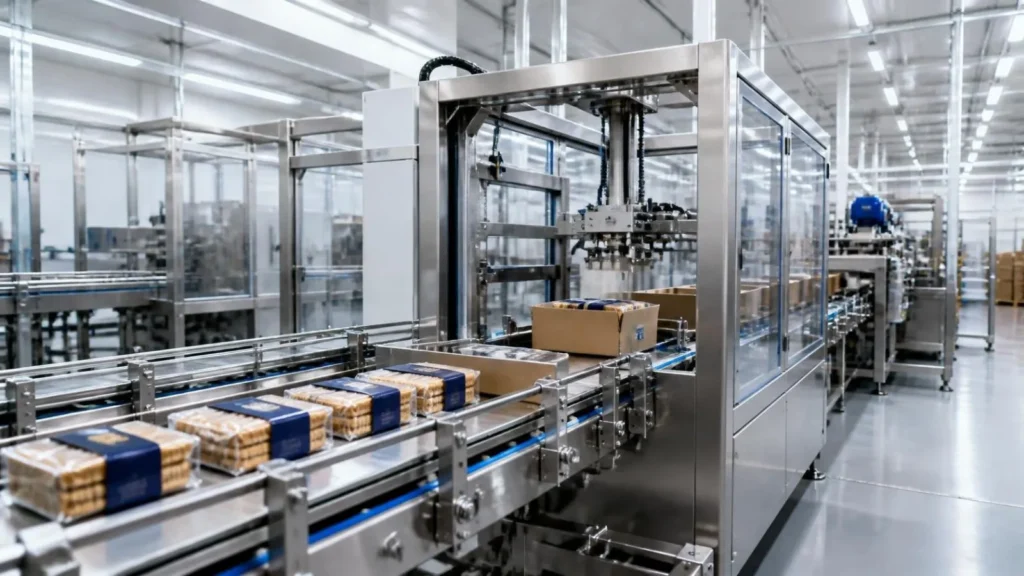
Summary A box packing machine helps food manufacturers improve packaging speed, hygiene, accuracy, and overall productivity by automating the loading of products or cartons into shipping cases. By reducing manual handling, maintaining consistent throughput, and integrating smoothly with cartoning, palletizing, and end-of-line systems, the right box packing solution can eliminate bottlenecks, support food-safety requirements, speed up changeovers, and keep production running efficiently across every shift. A biscuit packing line at a food plant loses rhythm at six in the morning. The wrapper runs true, but three cartons downstream sit stacked out of count. A worker steps in by hand, and the line loses forty seconds it will not recover. The plant has quietly lost output to a box packing machine sized two steps too small for the line. Packaging speed on a food line usually gets blamed on the filler or the sealer. More often it breaks down one station later, where product waits to be boxed correctly and fast enough to keep moving. A box packing machine is an automated system that loads food products or cartons into shipping boxes at a fixed count and pattern. It is located between the primary line and the palletizer, and its accuracy determines whether speed and hygiene go hand in hand. Why Food Industry Packaging Lines Lose Speed and Hygiene Compliance Manual box packing is where food lines lose their edge first. A trained operator can fold forty cartons a minute in hour one. By hour six, fatigue slows that rate, and the last human touchpoint becomes the highest risk. That gap moves downstream fast. A slow box packing station leaves the palletizer waiting and pushes truck loading past its scheduled window, right as the finished product sits closest to dispatch. According to Towards Packaging, the global cartoning machines market will grow from USD 9.16 Billion in 2026 to USD 14.27 Billion by 2035, with the food & beverages segment being the largest end-user of cartoning machines. How a Box Packing Machine Solves Speed and Hygiene Simultaneously An automated box packing machine holds the same fold and seal rate in hour eight as hour one. That consistency is a core piece of food packaging automation, removing the highest contamination touchpoint. A ready-to-eat meal producer running twelve SKUs is a workable example. At thirty-five cartons a minute, one machine keeps pace with the sealer without operator intervention. Alligator Automations engineers box packing systems for this production reality, covering horizontal, vertical, and wrap-around formats within its secondary packaging range. Horizontal box packing machines load product side-on into pre-erected cases, suited to biscuits and bakery cartons. Vertical box packing machines form and fill boxes from above, a fit for pouches and loose products. Automatic Cartoning Machine units erect and seal cartons ahead of the boxing stage. What Types of Box Packing Machines Work Best in Food Production? The right box packing machine format depends on product fragility, case style, and how often the line changes SKU. Wrap around packers suit high-volume, single-format lines such as beverages. Robotic pick and place packers use vision guidance for fragile items. Case packer machine setups with servo heads switch pattern in minutes. Side load packers suit lightweight cartons, limiting damage. For a broader look at how box packing machines are engineered and where each configuration fits, see our detailed guide on What Is a Box Packing Machine? Types & Benefits in Secondary Packaging. How Do Case Packer Machines Compare to Automatic Cartoning Machines for Food Lines? A case packer machine loads finished cases for shipping, while an Automatic Cartoning Machine forms and seals the individual carton earlier in the same food packaging line. The two machines solve different problems on the same line. A cartoning unit takes loose or bagged product and folds it into a single retail carton, sealed and ready for shelf. A case packer then takes several of those finished cartons, or loose product, and loads them into the outer shipping case that moves toward palletizing. A dairy or supplement line often needs both stages back-to-back. Cartoning handles the primary pack close to the product, where hygiene rating and gentle handling matter most. The case packer downstream can run faster and heavier duty, since the product is already protected inside its retail carton by that point. Table 3: Case Packer Machine vs Automatic Cartoning Machine Factor Case Packer Machine Automatic Cartoning Machine Line position After primary pack, before palletizing Directly after filling or bagging Product handled Cartons, pouches, bottles into cases Loose product into a single carton Typical speed 20 to 40 cases per minute 60 to 150 cartons per minute Best fit Multi SKU secondary packaging Primary retail pack for food and dairy Choosing between them is rarely a real choice on a food line, since the two units usually sit in sequence rather than compete for the same job. The decision that matters is changeover speed and hygiene rating on each station, since a mismatch between the two stages creates the same bottleneck a single wrong specification would. Alligator Automations builds both categories within its secondary packaging range, so a food producer can specify a cartoning stage and a case packer from a single line partner instead of matching machines from separate vendors. That single-source approach keeps hygiene rating and controls consistent across both stations. How Do You Choose the Right Box Packing Machine for a Food Production Line? Three inputs decide the correct specification: cartons per minute, product fragility, and how often the line changes SKU or pack format. Throughput target sets the baseline, since fast lines need dedicated mechanical heads. Product handling needs to decide vacuum or gripper loading for bakery items. Case style must be confirmed early, since case types need different forms. Hygiene rating matters for washdown areas and food-grade cleaning. Getting this wrong shows up fast. A box packing machine specified below real throughput becomes the bottleneck within a shift, and the mismatch usually surfaces first at the palletizing solutions stage