
Checklist: 12 Questions to Ask Any Belt Conveyor Manufacturer Before You Buy
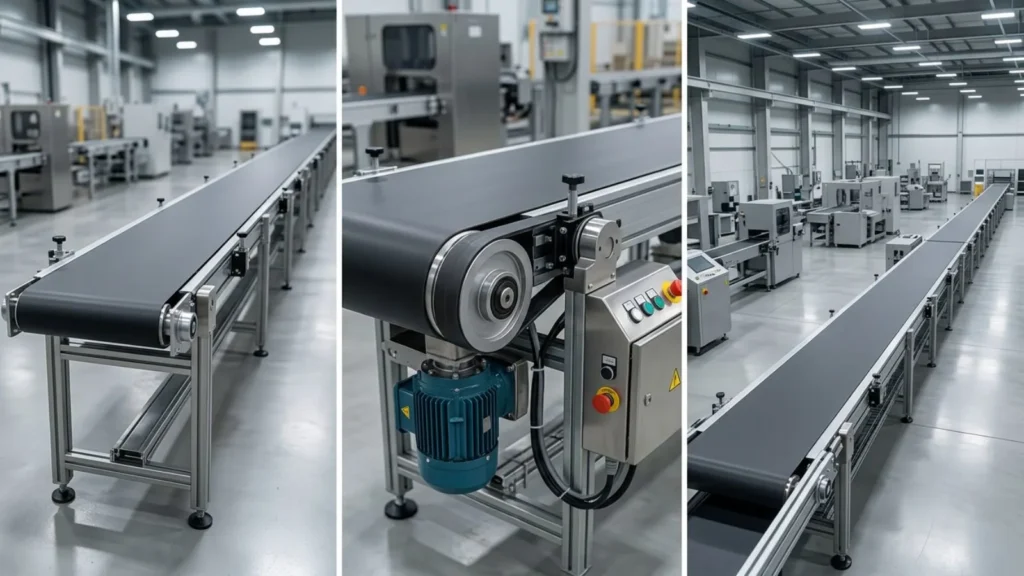
Summary A practical 12-point checklist to help manufacturers evaluate belt conveyor suppliers based on performance, engineering, integration, support, and total cost. It highlights the critical questions procurement and plant teams should ask before selecting a conveyor partner. The checklist also helps identify potential risks related to load capacity, downtime, warranty coverage, spare parts, and long-term system reliability. Introduction Choosing the right belt conveyor manufacturer involves more than comparing belt width, motor rating, and price. The right supplier should understand actual throughput, load conditions, operating environment, system integration, and long-term service requirements before recommending a belt conveyor system. Asking the right questions before purchase can help avoid unexpected downtime, performance issues, and additional operating costs. Six months after installation, a belt conveyor at a bagging plant is already tracking off center twice a shift. The warranty covers parts, not the four hours of downtime each incident costs. The plant signed with one of several belt conveyor manufacturers that quoted fast and asked almost nothing about the load profile. Most procurement teams treat conveyor buying as a datasheet match, belt width against motor rating. The twelve questions below cover what that datasheet leaves out, and what actually decides whether the line runs years without incident or fails within two quarters. Belt conveyor manufacturers are the companies that are responsible for the design, engineering, and construction of continuous belt systems which transport product or bulk material within a plant. Their scope covers frame fabrication, belt selection, drive sizing, and how the conveyor connects to existing line equipment. Why the Wrong Belt Conveyor Manufacturer Costs More Than the Machine A conveyor priced below the field usually got there by cutting somewhere. Undersized drives strain under real load, and frame steel gauge drops below what continuous duty needs. The failure rarely shows up during commissioning. It shows up once seasonal volume pushes the line past what the quote accounted for. Future Market Insights projects the global market for conveyor systems to expand at a 5.5 percent CAGR from USD 7.3 billion in 2026 to USD 12.4 billion by 2036, with warehouse distribution activity driving conveyor equipment replacement, and manufacturing plants adopting conveyors to reduce manual lifting on assembly lines. The same specification risk applies to roller conveyors, covered in the Roller Conveyor Buying Guide: Key Factors to Consider. What Are the 12 Questions to Ask a Belt Conveyor Manufacturer Before You Buy? The twelve questions below are split into 2 groups: design and capacity, then support and cost. Each one exposes a gap a rushed quote is built to hide. 1. Has the Load Rating Been Tested, or Only Estimated? A catalog load rating reflects average conditions, not the plant’s actual peak. Ask for test data at the heaviest expected load before signing, not after the first failure. 2. Do Belt Width and Speed Match Real Throughput? Sizing to a standard chart instead of the line’s actual output rate is a common cause of early capacity problems. Confirm the numbers were calculated against the plant’s real production data. 3. What Frame Material Suits the Operating Environment? Washdown, dust, and heat extremes each demand different frame and coating specifications. A manufacturer who does not ask about the environment before quoting is guessing at the material. 4. How Is Belt Tracking and Tensioning Controlled? Tracking drift is one of the most common belt conveyor failures, and it is almost always preventable. Ask what tensioning mechanism is employed and how misalignment gets corrected automatically rather than manually. 5. Does the Manufacturer Engineer In-House? A manufacturer who calculates load and drive specifications directly stands behind the numbers. One reselling a subcontracted frame is passing along someone else’s engineering and someone else’s risk. 6. Is Load Test Data Available Before Delivery? Test data proves a rating was verified on a bench, not assumed on paper. A manufacturer with nothing to share at this stage has likely not tested at all. 7. What Does the Warranty Actually Cover? Some warranties cover parts only, leaving labor and downtime as the plant’s cost. Confirm exactly what is included before treating warranty terms as a settled question. 8. What Is the Standard Lead Time? A quoted lead time that slips by weeks pushes back an entire installation schedule. Ask for a lead time backed by recent delivery history, not an optimistic estimate. 9. Is Service and Spare Parts Availability Local? Offshore only support turns a routine part replacement into a shipping delay measured in days or weeks. Confirm where the nearest spare parts stock and service technician are actually located. 10. Can the System Integrate With Existing Equipment? A belt conveyor rarely runs alone. Confirm it connects cleanly with the palletizers, control systems, and downstream equipment already installed on the line. 11. What Is the Total Installed Cost? The quoted machine price is rarely the full cost. Ask for commissioning, training, and freight included in one number before comparing it against another vendor. 12. Can the Manufacturer Provide References From a Similar Plant? A reference running a similar load profile confirms real performance rather than a sales claim. A manufacturer unwilling to provide one is worth a second look. Table 1: Quick Reference, Strong Signal vs Weak Signal Question Area Strong Signal Weak Signal Load rating (Q1, Q6) Tested at peak, data shared Catalog figure, no data Engineering (Q5) In-house calculation Subcontracted frame Warranty (Q7) Parts, labor, downtime Parts only Support (Q9) Local spares, service Offshore only Alligator Automations designs and tests belt conveyor systems in-house against these exact criteria, within its conveyor range, rather than sourcing frames from a third party and reselling them under its own name. What Happens When These Questions Get Skipped? A rushed belt conveyor selection rarely fails on day one. It fails months later, at the exact moment a plant can least afford the downtime. A fertilizer bagging line took delivery of a new belt conveyor last spring. The vendor matched the quote to the RFQ numbers on paper: belt width, motor
Automatic Conveyor Systems: A Comprehensive Guide to Functionality and Benefits
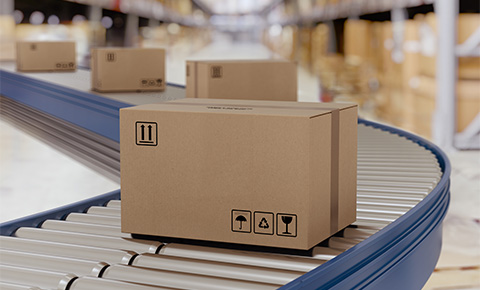
Automatic Conveyor Systems: A Comprehensive Guide to Functionality and Benefits Automatic conveyor systems have become essential in modern industrial settings, helping reduce material handling inefficiencies while boosting productivity in warehouses, distribution centres, and manufacturing facilities. Automatic conveyor systems are at the forefront of mechanical engineering and are designed to efficiently move products of various sizes—from light packages to heavy cargo like wooden pallets—with precision and control. Alligator Automations, a global leader in industrial conveyor automation, specializes in high-performance, flexible conveyor systems tailored to meet the rigorous demands of today’s industries. What Are Automatic Conveyor Systems? Automatic conveyor systems, also known as automated material handling systems, consist of powerful, technologically advanced equipment that efficiently transports items throughout a facility. Their main advantage is reducing manual labour and enhancing accuracy, with the flexibility to integrate seamlessly into existing operations. Alligator Automations offers a range of automatic conveyors for packaging, including tyre handling conveyors and product handling conveyors like cases, bags and crates – each customized for specific industry needs, ensuring optimal efficiency and reliability. Functionality of Automatic Conveyor Systems: Automatic conveyor systems are fully integrated into facility operations to streamline multiple processes: Efficient Product Transportation: The primary role of conveyor systems for logistics is to transport goods across the facility efficiently, whether moving raw materials to production lines, finished products to packing areas, or pallets to loading bays. Sorting and Distribution: Automatic conveyor for packaging can sort items by size, weight, or destination, making distribution smoother and reducing manual labour requirements. Inventory Management: With features like buffer zones (accumulation areas), automatic conveyor systems aid in managing inventory flow and tracking items in real time. Benefits of Automatic Conveyor Systems: The advantages of automated conveyors for businesses of all sizes are: Cost Efficiency: By enhancing product movement and process efficiency, automatic conveyor systems reduce lead times, increase production capacity, and lower reliance on manual labour. Increased Output: Relieving workers from repetitive tasks like handling and moving products allows employees to focus on higher-skill activities, leading to increased productivity and output. Thus proving conveyor system efficiency. Improved Workplace Safety: Reducing the need for manual lifting minimizes the risk of injury from handling heavy loads. Lower Operational Expenses: While initial setup costs may be high, automatic conveyor systems lead to long-term savings by lowering labour costs, reducing product damage, and increasing overall efficiency. Optimized Resource Allocation: When tailored to specific facility needs, industrial conveyor automation systems handle high volumes, ensuring efficient load management. Improved Organization and Flow: Automatic conveyor systems improve workflow organization, reducing backlogs and disruptions in product movement, and allowing for a seamless, organized facility. Alligator Automations: Your Partner in Automatic Conveyor Systems Alligator Automations, the leading provider of industrial conveyor automation and solutions, offers a comprehensive range of automatic conveyor systems that meet the specific needs of your business. We provide solutions for various applications, including: Tyre Handling Solutions: Optimize your tyre and wheel manufacturing processes with specialized automatic conveyor systems designed for safe and efficient tyre handling. Pallet Handling Solutions: Increase your operation’s throughput with automatic pallet handling conveyor systems, ideal for moving large and heavy products. Product Handling for Cases, Bags & Crates: Move product cases efficiently within your warehouse using our automatic conveyor systems configured to your specific needs. Conclusion: Alligator Automations understands that every business has unique requirements. Our team of experienced engineers works closely with you to design and implement a customized automatic conveyor system that integrates with your existing workflows and maximizes your operational efficiency. Investing in automatic conveyor systems represents a strategic decision for businesses looking to streamline operations, enhance productivity, and gain a competitive edge. Contact Alligator Automations today to explore our comprehensive range of automatic conveyor systems and discover how we can transform your material handling processes. FAQs 1] What is an automatic conveyor system? An automatic conveyor system is a mechanized setup that transports materials or products within a facility, reducing manual labour and enhancing workflow. 2] How does an automatic conveyor system work? It operates using programmed controls to move items along conveyor belts, rollers, or chains, efficiently coordinating the transfer of goods through each stage of production. 3] What industries benefit from automatic conveyor systems? Industries like food and beverage, chemical and petrochemical, warehousing, manufacturing, and automotive benefit from these systems, especially for sorting, packaging, and handling heavy items. Alligator Automations serves multiple sectors with customized conveyor systems. 4] What are the main types of automatic conveyor systems? Key types include belt conveyors, roller conveyors, chain-driven conveyors, modular conveyors, slat chain conveyor and pallet conveyors, each serving specific loads and operational needs. 5] What are the advantages of using an automatic conveyor system? They increase productivity, enhance safety, reduce labour costs, and improve space utilization, making operations smoother and more efficient. Alligator Automations designs solutions that deliver these benefits across various industries.