From Manual to Automated: Fertilizer Packaging with Automatic Bagging Machine and Robotic Palletizing
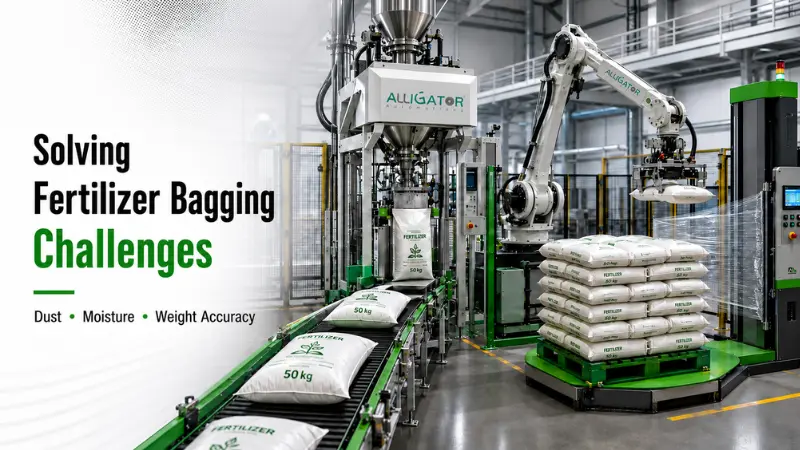
From Manual to Automated: Fertilizer Packaging with Automatic Bagging Machine and Robotic Palletizing system Author : Srinivas Choudhary How Alligator Automations replaced a manual, moisture-prone, dust-heavy bagging operation in Gujarat with load-cell precision filling, robotic palletizing, and automated pallet wrapping. Executive Summary A mid-size NPK fertilizer manufacturer in Gujarat faced critical challenges in its 50 kg fertilizer bagging line: inconsistent bag weights, moisture absorption leading to product caking, airborne dust affecting worker safety, and inefficient manual palletizing. Alligator Automations deployed a comprehensive end-of-line packaging automation solution integrating precision automatic bagging systems, load-cell-controlled filling, robotic palletizing, and pallet wrapping. Key Achievements: Improved bag weight accuracy by ±2%, eliminating underweight complaints Increased bagging speed by 35%, boosting production throughput Reduced moisture-related caking incidents by 80% Reduced airborne dust by 75% using integrated dust extraction systems Improved pallet stability, reducing load-shift incidents during transit Redeployed manual labor to quality assurance and process monitoring Introduction & Background The Fertilizer Industry in Gujarat Gujarat is a major hub for fertilizer manufacturing and agrochemical packaging, producing millions of tons of NPK (nitrogen, phosphorus, potassium) fertilizers annually. The state’s strategic location, skilled workforce, and industrial infrastructure have established it as a leading center for agricultural inputs manufacturing. Challenges in Fertilizer Bagging Operations Fertilizer packaging—particularly 50 kg sack bagging—represents one of the most demanding material handling applications in agriculture: Hygroscopic — absorbs ambient moisture, caking and losing nutrient value. Dust generation — granular/powder mix throws airborne particulate. Weight consistency — 50 kg of accuracy is a hard commercial requirement. Physical strain — manual stacking of 50 kg sacks is injury-prone. The Client’s Operational Challenge The client operated a largely manual fertilizer bagging operation lacking the precision, automation, and environmental control needed for modern distribution requirements. Manual labor, rudimentary weight control, and open-air filling created significant operational inefficiencies. Problem Identification & Objectives Each issue compounded with the following: slow manual filling meant longer open-bag dwell time, more moisture, more dust, and more product loss. Problem 1: Inconsistent Bag Weights ±5–8% weight variance per bag, far exceeding acceptable tolerances 12–15% of bags below nominal 50 kg, triggering customer complaints Compensatory overfilling resulted in 3–5% product giveaway, impacting margins Problem 2: Moisture Absorption & Caking Bags open 2–3 minutes per cycle, exposing product to ambient moisture 40–50% increase in caking incidents during high-humidity seasons Customer complaints about degraded fertilizer damaged brand reputation Problem 3: Dust Generation & Occupational Health Heavy airborne dust reduced visibility and necessitated frequent equipment cleaning Workers reported respiratory discomfort and inconsistent PPE use 2–3% product loss due to dust settling on pallets Problem 4: Inefficient Manual Palletizing Manual stacking of 50 kg bags led to worker fatigue and injuries Inconsistent stacking caused 5–7% pallet damage during transit Slow throughput created production bottleneck Strategic Objectives Achieve ±2% bag weight accuracy to eliminate underweight complaints Reduce bag dwell time from 2–3 minutes to <30 seconds Reduce airborne dust by at least 70% Increase production throughput by 30% or more Reduce transit damage to below 1% Redeploy manual labor to higher-value quality control activities Analysis & Evaluation Before designing the fix, the line was evaluated against tolerance, dwell time, and dust benchmarks — the three variables that unlocked every downstream improvement. Finding Before After Bags within weight tolerance ~60% (±5%) 98.5% (±2%) Underweight bag rate 12–15% <0.5% Bag open / dwell time 2–3 min 18–22 sec Caking incidents Baseline −80% Airborne dust ~8 mg/m³ ~2 mg/m³ Palletizing throughput Manual crew 600–800 bags/hr Pallet load-shift 5–7% <1% Methodology & Approach Complete End-of-Line Packaging Automation Solution Alligator engineered a holistic, integrated system addressing all interconnected challenges simultaneously, rather than implementing point solutions. Every component was specifically designed for the corrosive, dusty, hygroscopic demands of fertilizer bagging. Component 1: Precision Automatic Bagging with Load-Cell Control Load-Cell Weighing: Fills each bag to exact 50 kg ±2% target using real-time feedback Rapid Filling: 18–22 second cycles reduce bag dwell time by 80% Corrosion-Resistant Design: Stainless steel components withstand NPK fertilizer environment Integrated Dust Extraction: Capture hood extracts dust at source Component 2: Automated Bag Closing & Flattening Automatic Stitching/Heat-Sealing ensures secure, consistent closures Secondary Dust Extraction captures residual dust Bag Flattening achieves uniform shape for efficient stacking Component 3: Conveyor System for Continuous Material Flow Closed-loop conveyors transport bags directly from closing to palletizing Stainless steel/coated components ensure durability Speed synchronized with bagging system creates balanced workflow Component 4: Robotic Palletizing System Industrial robotic arm with vacuum gripper automates pallet building Precision Stacking in pre-defined patterns (4×4 or 5×4 per layer) Interlocked Layers rotated 90° resist shifting during transport 600–800 bags/hour throughput matches or exceeds manual teams Component 5: Automatic Pallet Wrapping Stretch-wrap film provides moisture and dust barrier Protects fertiliser during storage and transit Further secures interlocked stacks against vibration-induced shifting Fully automated application ensures consistent coverage Implementation Plan The five stations were commissioned as one coordinated program rather than five separate projects. Phase Focus Outcome 01 Engineering & design Load-cell filling and dust-extraction design specified for the client’s formulation and bag format 02 Fabrication Stainless-steel components built for the corrosive, hygroscopic environment 03 Installation & integration All five stations installed and synchronized as one closed-loop line 04 Validation & workforce transition Targets validated live; labor retrained into QA and monitoring roles Results & Expected Outcomes Concrete Results (6 Months Post-Implementation) Weight Accuracy & Quality: 98.5% of bags within ±2% of target Underweight rate: <0.5% (down from 12–15%) Annual cost recovery: ₹12–15 lakh Moisture & Caking Control: 80% reduction in caking incidents 35–40% lower moisture content in stored bags Zero customer complaints related to caking Dust Control & Safety: 75% reduction in airborne dust Eliminated respiratory health complaints Material recovery value: ₹18–20 lakh annually Production Efficiency: Daily throughput increased 62% (40 to 65 pallets) Cycle time: 18–22 seconds (vs. 2–3 minutes previously) Annual incremental production: 8,000–10,000 pallets Logistics & Damage Reduction: Load-shift incidents: From 5–7% to <1% Transit damage claims: Reduced 90% Customer satisfaction: Significantly improved Long-Term Expected Outcomes Market Competitiveness: Access to premium distribution channels with stricter compliance standards Scalability: Handle 30–40% more annual volume without facility expansion Cost Reduction: ₹35–45 lakh annual savings from optimized operations Worker Safety: Improved conditions support talent retention and reduce compensation claims Environmental: Reduced emissions support air quality regulations and ESG requirements Conclusion & References Summary of Impact Alligator Automations delivered a transformative solution addressing all core challenges simultaneously: Weight Accuracy: ±2% consistency
Bag Filling Machines: Automatic vs. Manual Which Is Right for Your Business?
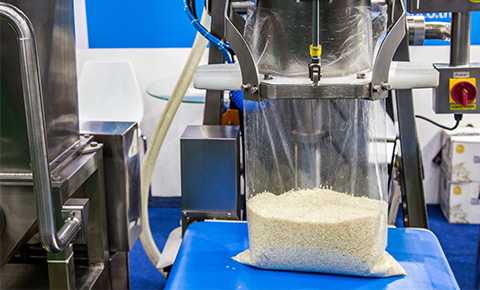
Automatic vs. Manual Bag Filling Machines: Which Is Right for Your Business? In the competitive manufacturing landscape, where production volume, quality, and cost efficiency are crucial, effective packaging is essential. Bag filling machines are a key part of this process, with two main types: automatic bag filling systems (mechanized) and manual bagging process. However, understanding the difference between the two filling machine types can help businesses choose the best option for their needs. The Case for Manual Bag Filling Manual bagging process can be beneficial for businesses with low production volumes. In this setup, workers place empty bags under a filling spout, fill them to a set weight, and then seal them by hand. However, there are several challenges with this approach: Low Production Rate: Manual processes have limited scalability. As demand grows, manual bagging often cannot keep up the bag filling efficiency, thus limiting business growth. Inconsistent Accuracy: Manual bagging process can vary, leading to bags that may be overfilled or underfilled. Overfilled bags increase costs, while underfilled bags can lead to dissatisfied customers or legal issues. Rising Labour Costs: While manual filling may have lower initial costs, labour costs in manual bag filling can quickly add up. With rising labour costs, manual bagging may not be sustainable for businesses in the long run. Safety Concerns: Repetitive manual lifting and bending can lead to workplace injuries and fatigue. The Power of Automatic Bagging System Automatic bag filling machines address many limitations of manual bagging processes, offering several advantages for industrial operations: Bag Filling Efficiency: Automatic bag filling machines operate much faster than manual methods, significantly increasing production rates and handling larger volumes with ease. Superior Filling Accuracy: Our filling machine types are equipped with adjustable settings and accurate weighing systems, ensuring each bag is filled to the exact weight, reducing product waste and satisfying customers with consistent quality. Lower Labour Costs: Automation minimizes the need for manual labour, freeing employees to focus on higher-value tasks and reducing overhead. Improved Safety: With fewer moving parts handled manually, automatic bagging systems create a safer work environment by minimizing the risk of workplace injuries. Increased Hygiene: Automatic bagging machines prevent direct human contact with the product, helping maintain hygienic conditions, especially crucial in industries like food and pharmaceuticals. Selecting the Right Bag Filling Machine for Your Business Alligator Automations offers versatile bag packing machines that meet industry standards and adapt to various operational needs. Our automatic bagging for large-scale operations can handle bags from 20 kg to 2000 kg, providing the flexibility to meet a wide range of bagging requirements. Whether you require an open-mouth filling system for pre-formed bags or a robust FIBC jumbo bag filling machine for large-scale operations, Alligator Automations has the perfect solution to optimize your bag filling process. Our high-speed bag filling machines boast features like data logging, IoT compatibility, and customizable designs to ensure a perfect fit for your specific requirements. Conclusion Investing in an automatic bag filling machine is a strategic decision that can transform your packaging operations. With increased efficiency, improved product quality, and reduced labor costs, automatic bag filling machines offer a compelling return on investment. Contact Alligator Automations now to explore our range of bag filling machines and discover how we can help you streamline your production process and achieve new levels of efficiency. FAQs What are the advantages of using an automatic bag filling machine? They reduce labour costs, increase packaging speed, improve accuracy, and ensure consistent quality. Our automatic solutions support 24/7 operation, enhancing productivity. When is a manual bag filling machine more suitable? Manual machines are better for small operations with low-volume needs and lower budgets. How do I determine which machine is best for my business size? Consider production volume, budget, and desired automation level. Alligator Automations provides scalable options for various business sizes. Can an automatic bag filling machine improve efficiency in my production line? Yes, an automatic machine can streamline production, cut labour costs, and maintain consistent output