
How to Reduce Truck Loading Time in Industrial Warehouses: Everything You Need to Know About Automatic Truck Loading Systems

Warehouse studies have shown that loading and unloading operations can account for roughly 30–40% of total warehouse labor activity, and delays during dispatch frequently slow down the entire outbound logistics process. When trucks sit idle waiting to be loaded, dock utilization drops, dispatch schedules slip, and warehouse traffic quickly becomes congested.
Despite advances in warehouse automation, truck loading in many plants is still handled using forklifts and manual pallet movement. This method is workable at smaller scales, but once volumes increase, the process begins to slow down significantly. Facilities that dispatch dozens of trucks per day often discover that the loading dock becomes the weakest point in the operation.
This is where automatic truck loading systems make a measurable difference. By the direct transfer of pallets from conveyor systems to trailers, the automation of loading pallets onto trucks eliminates repetitive manual handling.
Why Truck Loading Becomes a Warehouse Bottleneck
Products move through case packing, palletizing, and stretch wrapping systems with a predictable rhythm before reaching the dispatch area. Once pallets arrive at the loading dock, the system often switches from automated movement to forklift handling.
The operator picks up a pallet, drives it into the trailer, places it carefully, reverses out, and repeats the cycle. That sequence sounds simple. But multiply it by fifty or sixty pallets, and the loading time quickly adds up.
Depending on the layout of the warehouse and the number of forklifts available, loading a single truck can easily take 30 minutes to an hour. During peak dispatch periods, this creates a familiar scene outside many plants: trucks lined up at the gate waiting for dock access.
The issue is not production speed. The issue is how quickly goods can leave the warehouse.
What Are Automatic Truck Loading Systems?
An automatic truck loading system is designed to handle the final stage of warehouse dispatch without manual intervention.
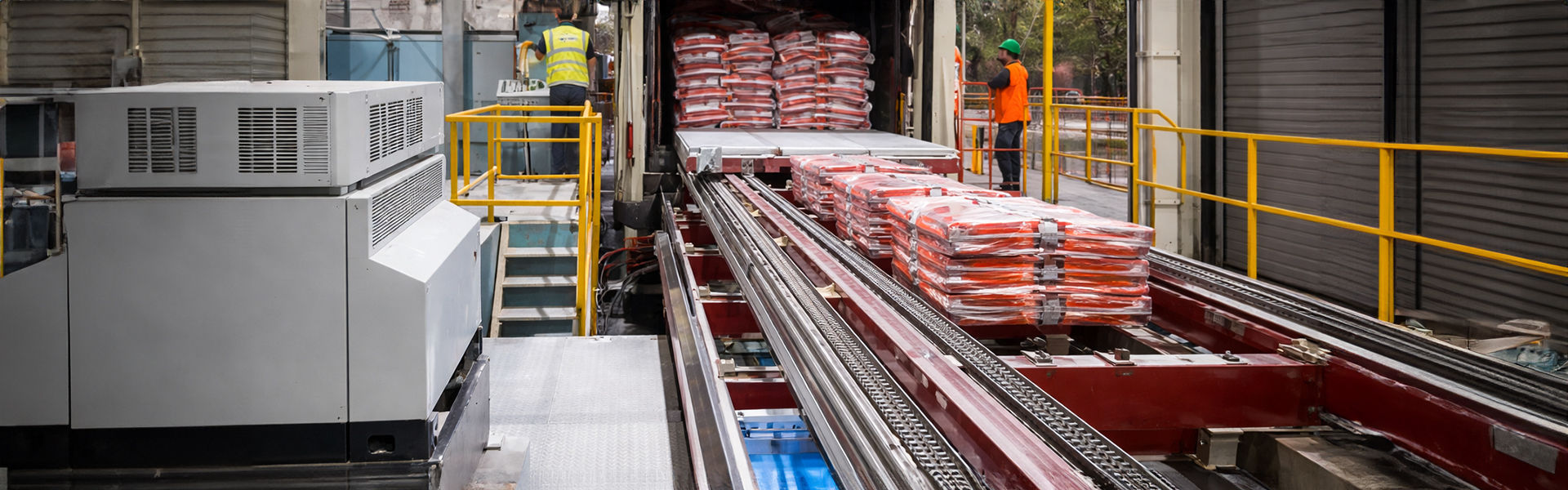
Instead of forklifts transporting pallets individually, automated loading systems connect the warehouse conveyor network directly to the truck loading dock. Pallets move through the conveyor line and are transferred into the trailer using automated loading platforms or telescopic conveyor mechanisms.
Most warehouses have an average truck loading system that integrates all of the following equipment, along with other packaging machinery:
- Intralogistics conveyor systems to carry pallets throughout the warehouse.
- Accumulation areas for dispatch, where multiple pallets are held prior to being loaded onto the truck.
- Automated or telescopic loading platforms that extend from the warehouse directly into the truck.
- Integrated control systems that coordinate both the movement of pallets and loading cycles.
Following the truck’s arrival at the check-in area of the loading dock, pallets are automatically moved to the truck by the automated loading system. This creates a continuous flow versus repetitive manual processes.
How Automatic Truck Loading Systems Reduce Loading Time
The biggest advantage of truck loading automation is consistency. Instead of depending on manual movement, the loading sequence becomes synchronized with the rest of the warehouse operation.
Continuous Pallet Movement
In a manual setup, every pallet movement requires a forklift trip. Automated systems eliminate that stop-and-start cycle.
Pallets travel through conveyor lines directly to the loading area, maintaining a steady flow toward the truck. Since the system does not pause between pallets, idle time disappears.
Handling Multiple Pallets in One Cycle
Forklifts can only handle one pallet at a time. Automated truck loading automation solutions can transfer multiple pallets during a single loading cycle.
This also significantly reduces the length of the loading window, especially for facilities that ship a high volume of pallets.
Truck Turnaround is Improved
As loading times decrease, trucks are on the dock for reduced periods of time. This decreases congestion in the dock area and has a positive impact on warehouse operations.
- More trucks can be dispatched during a single shift.
- Warehouse congestion is reduced.
- Transport scheduling becomes more predictable.
Facilities with multiple production lines often notice an immediate impact after implementing an automated loading system.
Enhanced Safety of Loading Operations
Another factor often overlooked is safety.
When multiple forklifts are moving in and out of the loaded trailer, the chance of collisions between forklifts, damage to pallets, and errors in loading increases dramatically.
Automating loading will minimize the number of movements conducted in and around your dock area, thereby helping to create a safer and well-controlled loading environment.
How Much Time Can Automation Save?
The exact savings depend on the warehouse layout and dispatch volume, but the contrast between manual and automated loading is significant.
In many industrial plants:
- Manual forklift loading: around 30–60 minutes per truck.
- Automated truck loading: roughly 5–10 minutes per truck.
Reducing truck loading time by 70–80% it significantly increases the volume of product that can be shipped out of the loading dock. Instead of expanding warehouse space or adding additional docks, many facilities achieve higher dispatch capacity simply by automating the loading process.
This improvement becomes especially important in industries such as FMCG, chemicals, cement, and food processing, where high pallet volumes must move out of the warehouse continuously.
Compatibility with Other Packaging Systems
Automatic truck loading systems are normally used in conjunction with other automated secondary packaging and distribution processes. In most facilities, the process flow would include:
In many facilities, the workflow looks like this:
- Case packers prepare products for transport.
- Robotic palletizers build stable pallet loads.
- Stretch wrappers secure pallets for shipping.
- Intralogistic conveyors move pallets across the warehouse.
Once the pallet reaches the dispatch zone, the warehouse truck loading system takes over and transfers it directly into the waiting truck.
Because each stage is connected, the movement of goods remains uninterrupted from packaging to dispatch. The continuous flow of pallets minimizes handling time, reduces the risk of product damage, and maintains a more efficient warehouse operation.
Conclusion
Truck loading has a major impact on warehouse performance. When dispatch relies on forklifts and manual pallet movement, loading docks quickly become the slowest part of the facility.
Automatic truck loading systems solve this problem by automating the final stage of dispatch. Quicker loading reduces congestion and improves overall warehouse throughput without the need for additional manpower in these operations.
Alligator Automations specializes in the design of full packaging or dispatch lines by integrating bagging equipment, intralogistic conveyors, case packers, depalletizers, robotic palletizers, stretch wrappers, and Automatic Truck Loading (ATL) systems. Their solutions provide proper results while maintaining the same level of quality with lifetime support.
For facilities that wish to improve efficiency with dispatching and decrease truck turnaround, an entirely automated packing line can help change how goods are moved from production to shipping.
FAQs
1) What are the most effective ways to reduce truck loading time in warehouses?
Automation, conveyor integration, and reducing forklift dependency are the most effective ways to speed up truck loading operations.
2) How does a warehouse truck loading system improve efficiency?
It automates pallet transfer from conveyors into trucks, eliminating manual loading and reducing dispatch delays.
3) What is a truck loading automation solution?
It is an automated system that loads pallets or goods into trucks directly from warehouse conveyors without manual handling.
4) How much time can automation save during truck loading?
Automation can reduce loading time from 30–60 minutes to roughly 5–10 minutes per truck.
5) Is truck loading automation suitable for all industries?
It is most beneficial for industries that dispatch large volumes of palletized goods regularly.
6) What are the main causes of slow truck loading in warehouses?
Forklift dependency, labor shortages, warehouse congestion, and inefficient dock layouts are common causes.
7) Does truck loading automation reduce labor costs?
Yes. Automation reduces the need for forklift operators and manual loading staff.
8) What is the ROI of installing a truck loading automation system?
ROI typically comes from faster dispatch cycles, reduced labor costs, and higher dock utilization.
9) Can truck loading systems integrate with conveyors and palletizers?
Yes. They are typically integrated with conveyors, palletizers, and stretch wrapping systems in automated dispatch lines.
10) How do I choose the right truck loading automation solution?
It depends on truck dimensions, pallet sizes, warehouse layout, and dispatch volume requirements.