
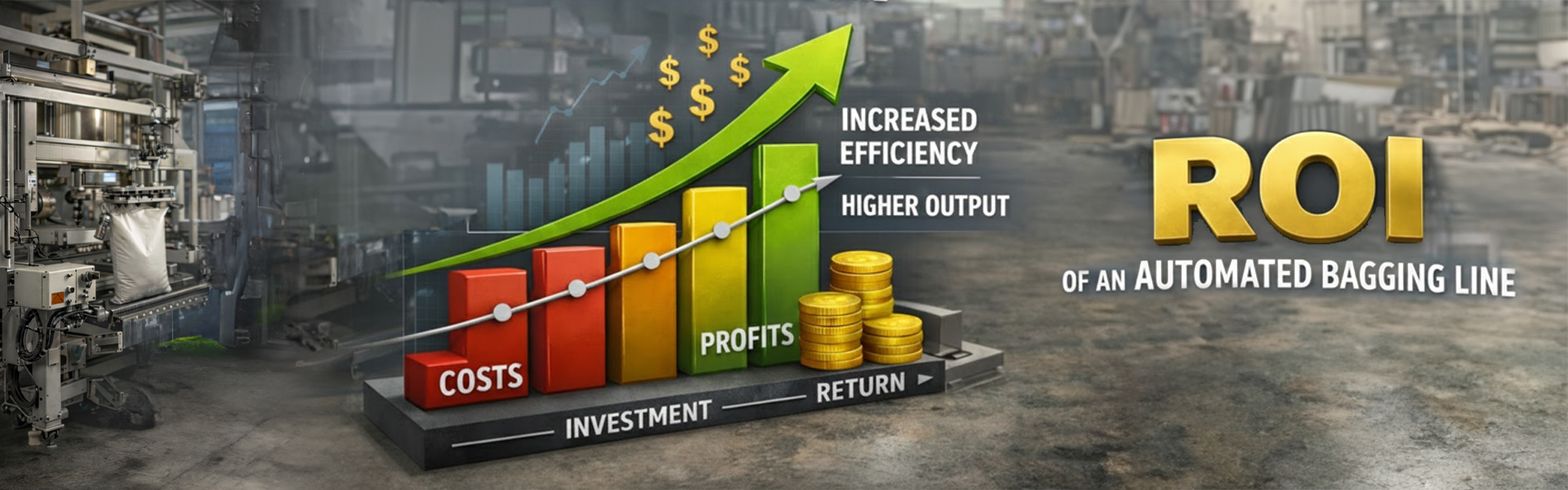
How to Calculate ROI of an Automated Bagging Line?

When a plant head signs off on a new Bagging Line, it is rarely because the machine looks impressive on the shop floor. It is because the numbers make sense.
Packaging is often where margins quietly leak. Extra labor on every shift. Inconsistent output. Minor spillage that no one tracks properly. Pallets are waiting because the downstream equipment isn’t synchronized.
Return on investment, or ROI, is simply a way of asking: will this automated bagging line pay for itself — and how fast?
Let’s walk through how experienced operations teams actually calculate it.
Step 1: Start With the Full Project Cost
The first mistake companies make is underestimating investment.
A realistic ROI calculation must include the complete secondary packaging system, not just the bag filling unit.
That typically covers:
- Automatic bag filling machine
- Intralogistic conveyor systems
- Case packer (if bags are packed into cartons)
- Robotic palletizer
- Stretch wrapping system
- Automatic truck loading interface
- Electrical panels and controls
- Installation, commissioning, and training
In modern facilities, bagging is not a standalone activity. It is part of a synchronized flow from filling to dispatch.
At Alligator Automations, automated bagging lines are designed as fully integrated systems, where conveyors, palletizers, and stretch wrappers operate as one continuous sequence. That integration directly influences ROI because it reduces friction between stages.
Once you have the true project cost, the analysis becomes meaningful.
Step 2: Understand Your Current Baseline
You cannot calculate the return unless you know what you are spending today.
Gather accurate data on:
- Number of operators per shift
- Annual labor cost per operator
- Overtime frequency
- Current output per hour
- Material loss or spillage rate
- Downtime hours per month
- Maintenance cost of the existing setup
Be honest here. Many plants underestimate soft costs like inconsistent stacking, rework, and dispatch delays. Those “small” inefficiencies compound over 12 months.
Step 3: Identify Direct Financial Gains
Now evaluate what automation changes.
1. Labor Cost Reduction
Suppose your current setup uses four operators per shift for bagging and palletizing. If automation reduces that to two, calculate annual savings clearly:
Annual labor savings = (Number of operators reduced × annual cost per operator)
Over three years, this alone can represent a substantial portion of the investment.
2. Throughput Enhancement
There will always be variation in manual systems due primarily to fatigue, shift changes, and variability in handling that leads to variances in production.
But an automated bagging line will run at a specific cycle rate from the start to the end of production. Therefore, if throughput were to increase 10%, this increase could result in:
- More products shipped
- Better on-time delivery
- Less backlog
With additional ability to produce means additional potential for revenue. Thus, when demand is steady, faster throughput means less operational pressure.
3. Decreased Product Loss
Automation increases accuracy in the filling process as well as in the control of the material as it is discharged. A reduction of just 1% in the amount of material lost could represent considerable savings on an annual basis, particularly for high-volume operations.
4. Decreased Downtime
By ensuring a smooth transition between the bag filling machine, conveyors, and robotic palletizers, the flow of products becomes more stable.
Step 4: ROI Calculation and Payback Period Calculation
To calculate the return on investment (ROI), first estimate annual savings. Then use the following formula:
ROI (%) = Annual Net Benefit / Total Investment Cost x 100
For example:
Total investment = $600,000
Annual savings = $180,000
ROI = (180,000 / 600,000) x 100 = 30%
Payback period = Total Investment / Annual Savings
= 600,000 / 180,000 = 3.3 years
For nearly all manufacturing companies with high-speed manufacturing processes, paybacks tend to be between 2 and 4 years.
Step 5: Consider Indirect Benefits
It’s important to remember that not all returns will show on an Excel spreadsheet right away.
Automation will also provide:
- Increased safety in the workplace.
- Uniformity with pallet quality.
- Maximum utilization of space in the plant.
- Simplifying compliance with your operational standards.
- Scalability for future growth.
A modular bagging line that integrates with conveyors, robotic palletizers, and stretch wrappers can be expanded without replacing core equipment. That future readiness protects capital investment.
Conclusion: ROI Depends on System Integration
An automated bagging line delivers real return only when it functions as part of a complete secondary packaging solution.
When bag filling integrates seamlessly with intralogistic conveyor systems, case packers, robotic palletizers, stretch wrappers, depalletizers, and automatic truck loading systems, operational efficiency compounds across the line.
At Alligator Automations, we design and deliver the entire packing and bagging line — engineered for performance, scalability, and cost-effective solutions without compromising on quality, backed by lifetime after-installation support.
If you are evaluating an investment, start with real production data. Calculate labor savings honestly. Factor in throughput stability.
When done properly, ROI is not an estimate. It becomes a predictable outcome.
FAQs
1] How do you calculate ROI for a bagging line?
Divide annual net savings by total project investment and multiply by 100 to get the ROI percentage.
2] What costs should be included when calculating bagging line ROI?
Include equipment, conveyors, palletizing integration, installation, controls, training, and commissioning costs.
3] What benefits impact the ROI of an automated bagging line?
Labor savings, higher throughput, reduced product loss, lower downtime, and improved operational consistency.
4] How long does it take to get ROI from an automated bagging line?
Typically between two and four years, depending on production scale and cost structure.
5] Does automation improve bagging line efficiency?
Yes. Automation stabilizes output, reduces manual handling, and minimizes interruptions.
6] Can a small manufacturing unit benefit from an automated bagging line?
Yes, particularly where labor cost or workforce availability is a challenge.